
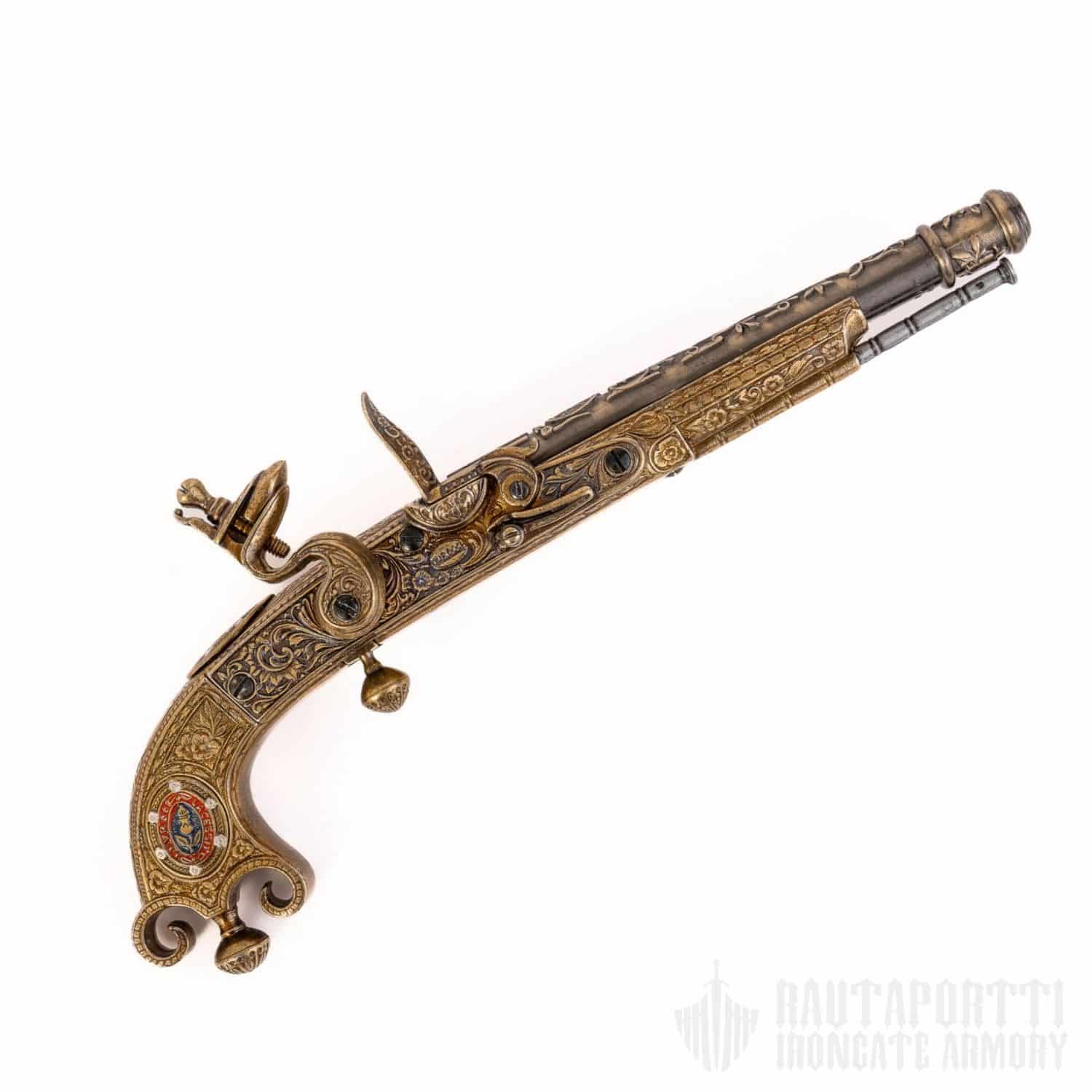
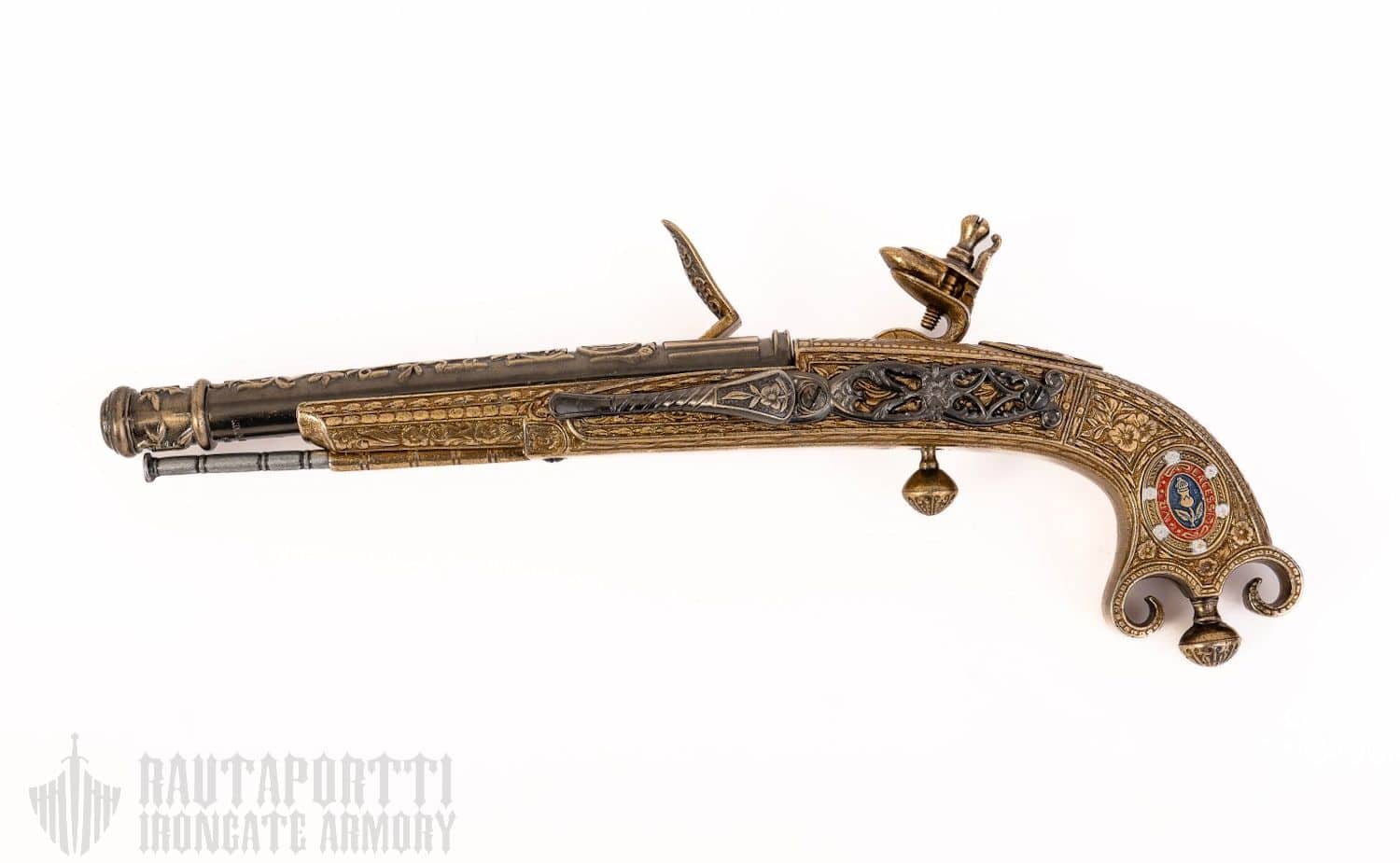


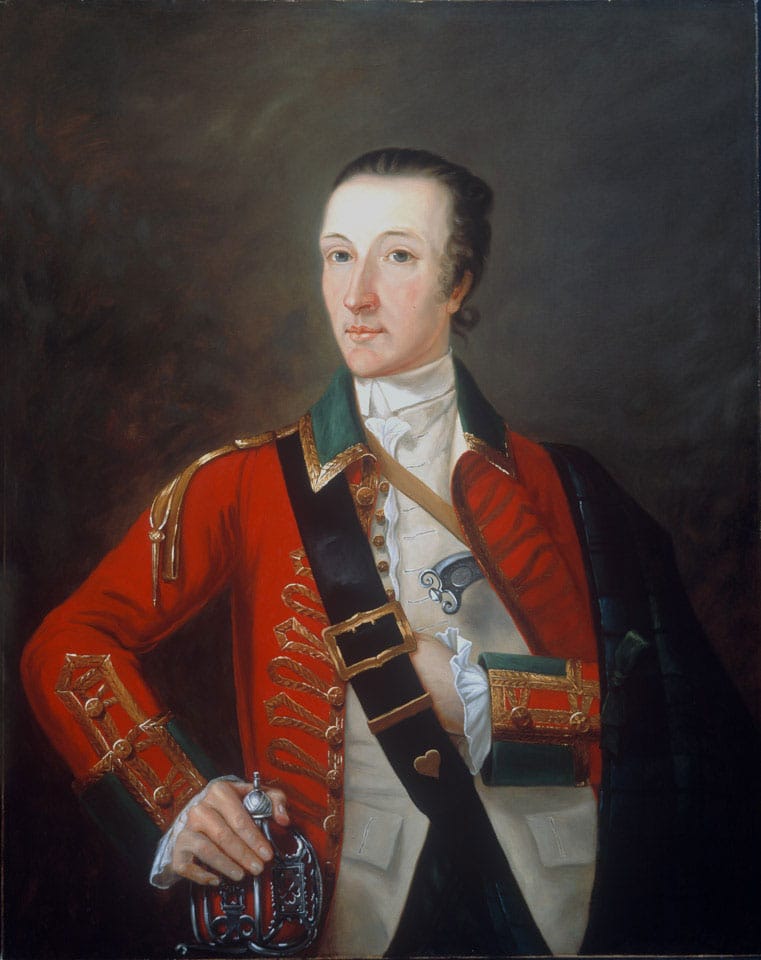
Scottish Murdoch Pistol, Scotland 1760
- Ornate Scottish pistol from the 1700’s made entirely of metal
- The model is named Murdoch, after one of the manufacturers
- Made of cast metal (zamak)
- Can be cocked and dry fired like the original
- Non-firing replica. Legal and permit free in most countries
- Excellent for theater and film productions
75€
• Pickup: Immediately from store in Kaarina, Finland
Description of the Product
The Scottish steel pistol is a unique firearm in the same proud Scottish tradition as kilts and bagpipes. The pistol was invented by Thomas Caddell around 1680 in Doune, near Stirling. At the time hardwood was hard to come by, which is why he decided to use a steel stock for his pistols. The pistols became so popular that many makers started to copy them, most famously Murdoch. To this day, Scottish steel pistols are sometimes called Doune or Murdoch pistols.
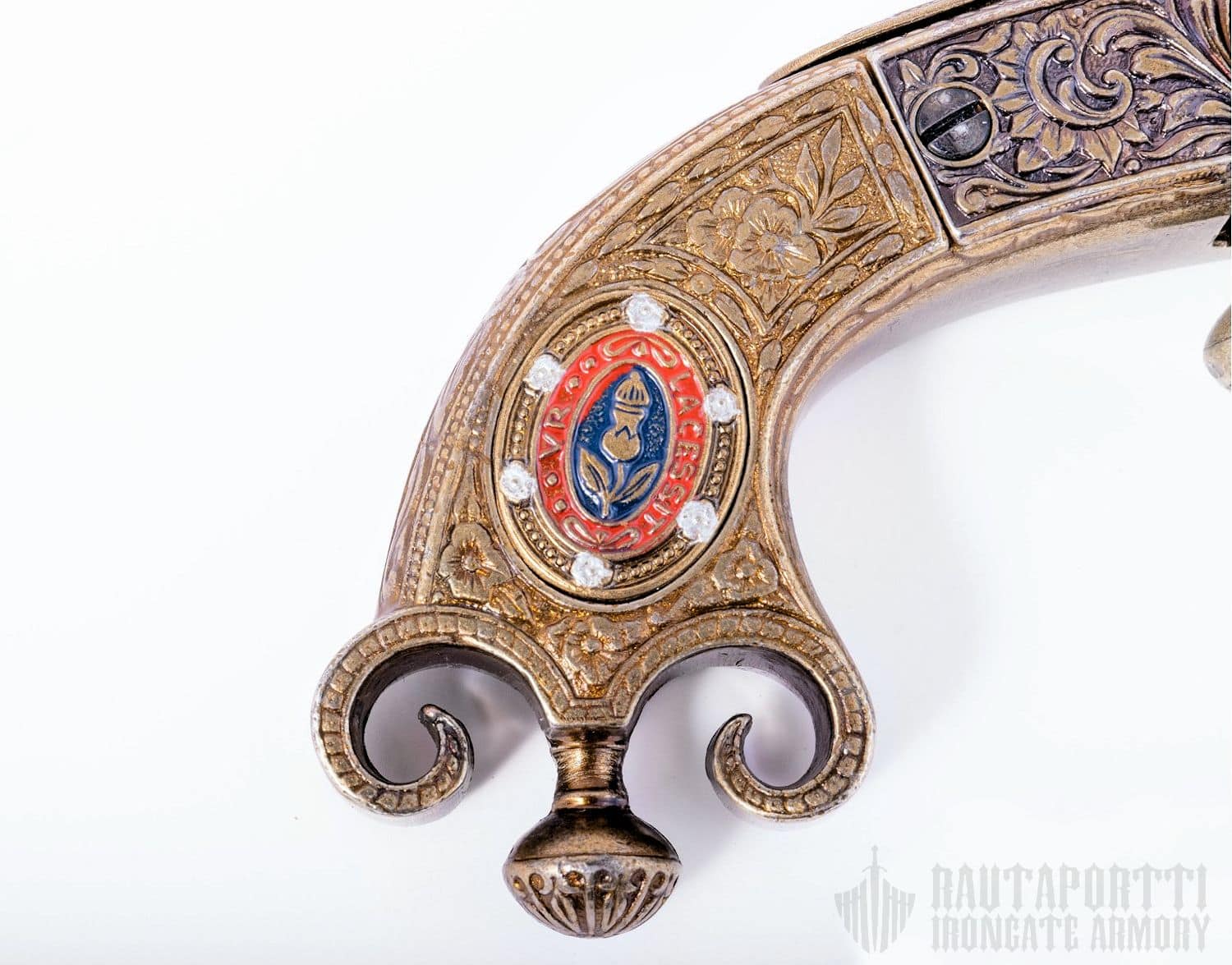
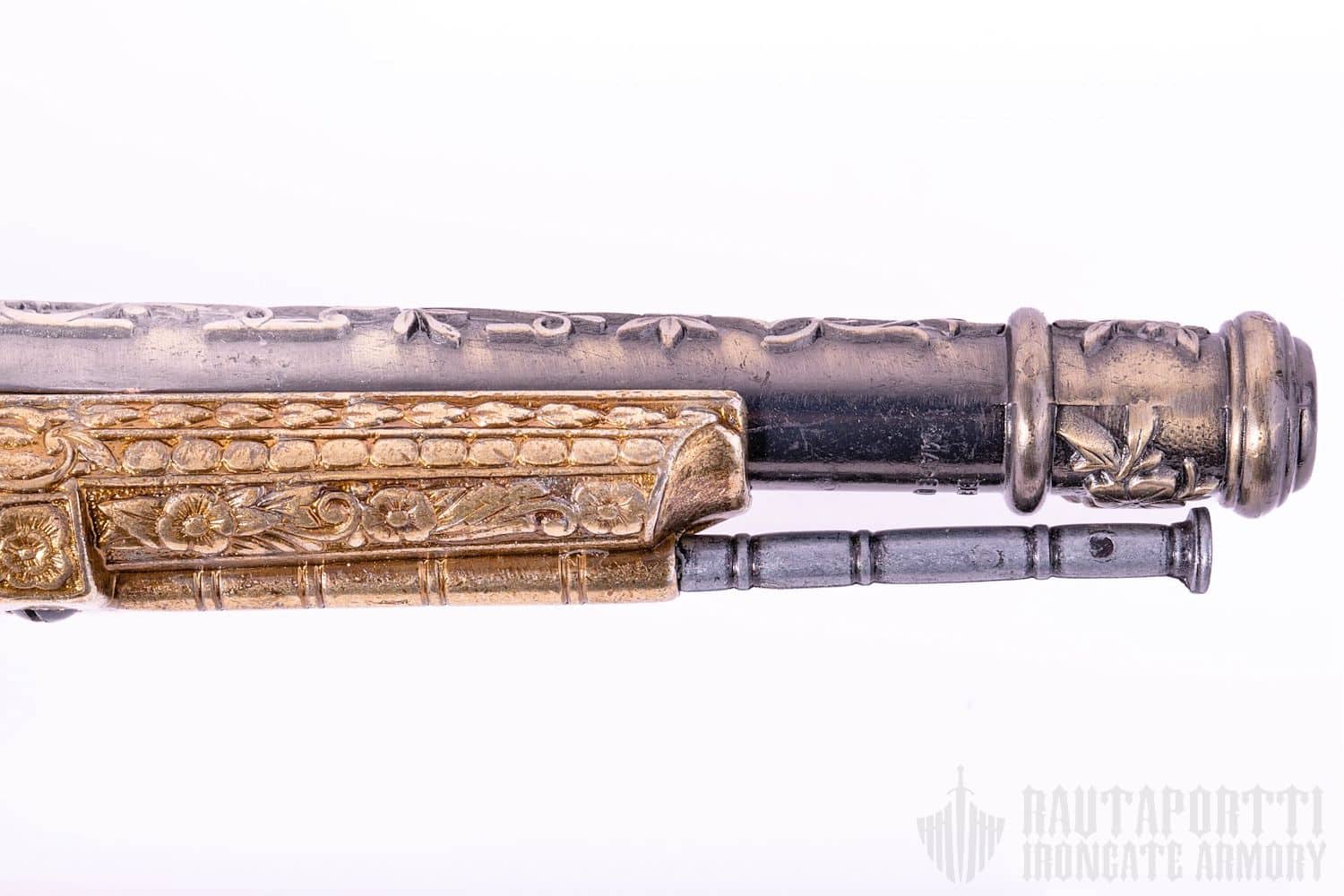
The most notable features of the Scottish pistol developed during the 1700’s, such as the scrolled “rams-horn” butts, ball triggers, and belt clips. The barrels too had a distinctive shape, as they were forged with fluted, round, and octagonal sections. The pistols also lacked a trigger guard, which made shooting faster, but also accidental shots common. The ball trigger is therefore somewhat stiffer than triggers on other flintlock pistols. Simple, unadorned versions were mass-produced and issued to infantrymen in Highland regiments, and elaborate ornate ones for officers and aristocrats. Pistols were considered requisite items for the Highland soldier as early as the 1730s. By the 1740s the elegant Doune pistol styles had become the most sought after amongst Highland officers.
The majority of Scottish muskets were destroyed following the failed 1715 and 1745 Jacobite rebellions. But many pistols survived, as they were easier to conceal, and the government was more lenient with the rich Scots and military officers who preferred the steel pistol. Even though some of the pistols survived, the Scottish gun industry, however, was nearly killed off by a combination of gun control from the Disarming Act and the Act of Proscription of 1746, in which any “side pistol, gun, or other warlike weapon” was prohibited along with traditional Highland dress, in an attempt to stamp out loyalty to the Stuarts. Competition from more inexpensive Birmingham gunmakers did not help. Despite these developments the pistols continued to be made, both privately and on Government contract for the officers and men of Highland regiments in the British Army. By the mid-1790s Highland Regiments abandoned their flintlock pistols, but they were still considered to be an essential part of formal Highland dress until about 1900. The wearing of the powderhorn as part of Highland dress, without the accompanying firearm, remained popular much longer; they just were converted into whisky flasks.
These steel pistols were carried by clipping them under the left arm, through the pistol's belt clip on a thin leather baldric. The vast majority of these pistols were profusely engraved throughout, often with traditional thistle or floral schemes, and they rank among the most elaborate and colorful Scottish-style firearms ever produced.
Many of the Murdoch pistols were in use during the French and Indian War, or Seven Years’ War, of 1754-1763. Supposedly, the first shot of the American Revolution was also fired from a Scottish Murdoch pistol, the so called “Shot Heard ‘Round the World” on April 19th 1775.
Today, basket hilted swords and pistols are no longer worn as part of contemporary Highland dress, except as parts of military uniform or historical clothing, and the dirk is reserved for pipers or the most formal of occasions. Today, only the sgian-dubh remains of the days when all Highlanders who could afford it armed themselves to the teeth even for formal occasions.
- This gun is an exact replica of the original. The replica matches the original in size and weight. The mechanisms of the weapon are working. The weapon can be cocked and dry fired like a real one. Due to the materials used, the mechanisms cannot withstand continuous cocking and firing for long periods.
- Cast metal has been used to make this replica weapon. Zamac differs from steel in many respects, so the structure of the gun does not withstand pressure, it cannot be used to fire bullets, nor can it be converted to a functional weapon by any means.
- Replica guns such as this do not require permits in Finland, nor in many other countries. However, since the gun looks real, it should not be carried in public.
- A replica gun is perfect for historical re-enactment, on a theater stage, in film productions, for collectors of historical memorabilia, and as decoration.
- Length: 31 cm
- Weight: 960 g
- Manufacturer: Denix, Spain
Due to the nature of this item please read about shipping options/restrictions if ordering outside Finland. –More information about international shipping-

Customer service is like the good old days, real people, very efficient, very fair. And they have LOTS of amazing gear for sale. Cheers and thank you Rautaportti!!!
Customers who bought this were also interested in...


You may also like…


Products are located in our own storehouse
In Kaarina, Finland.
Fast shipping
Orders are shipped out within 24 hours of us receiving the order.
Purchase online or offline
You can also pickup your order at our store.
Flexible payments
We accept Credit Cards & Online Banks etc.
Our Store
All orders can also be picked up from the brick-and-mortar store at Oppipojankuja 1, 20780 Kaarina. 10min drive from the centre of Turku.
Welcome!
Reviews
There are no reviews yet.