
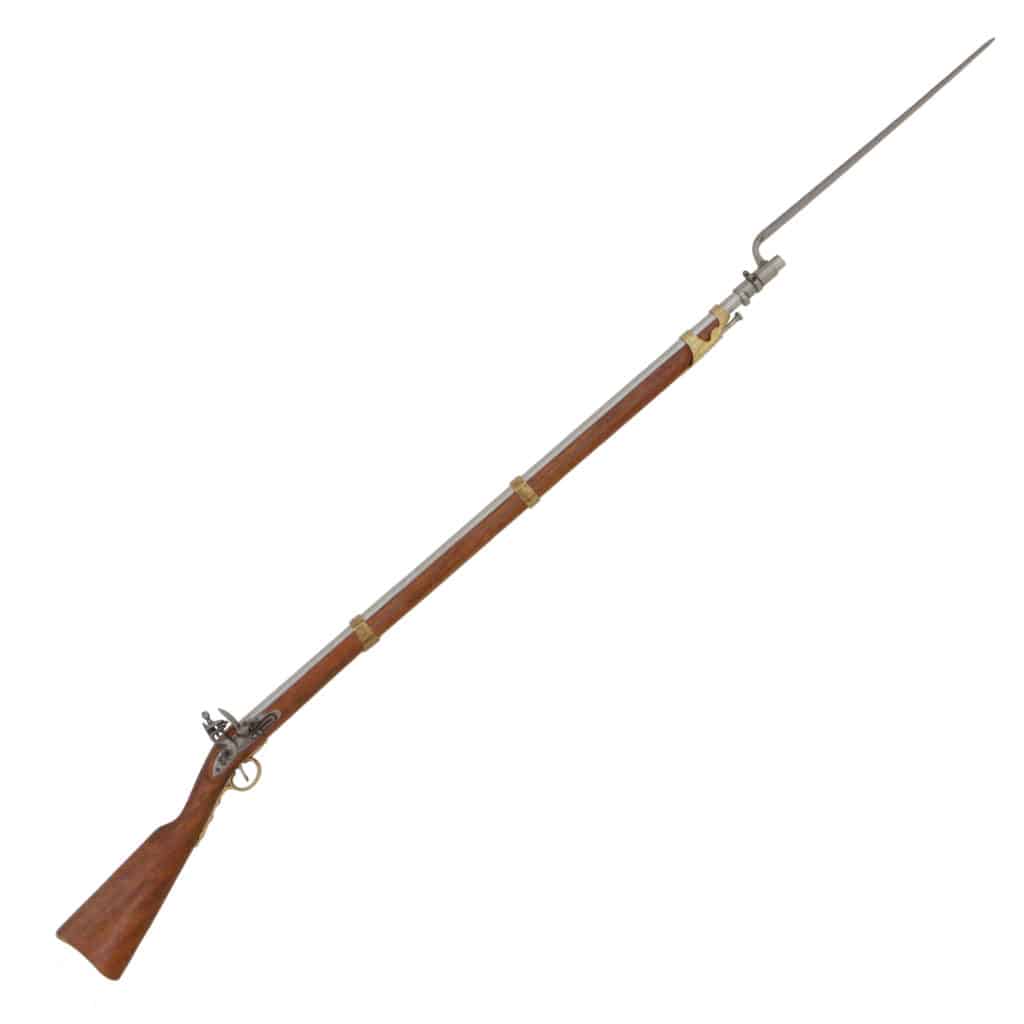


Charleville Flintlock Musket with Bayonet, France 1777
- Made of cast metal (zamak) and hardwood
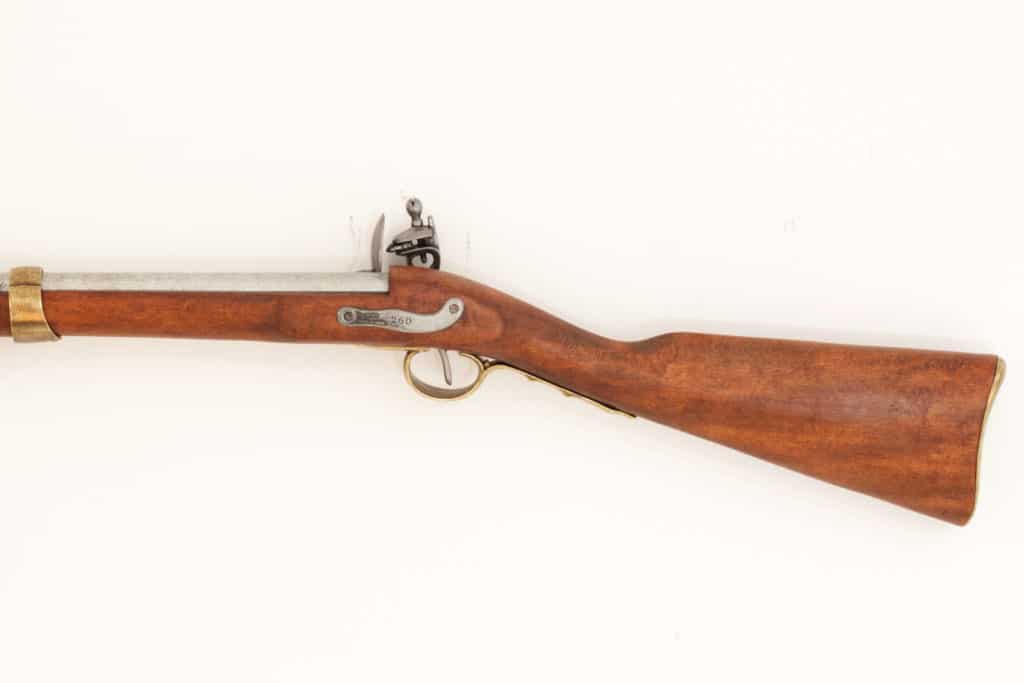
- Can be cocked and dry fired like the original
- Non-firing replica. Legal and permit free in most countries
- Excellent for theater and film productions
169.90€
• Pickup: Immediately from store in Kaarina, Finland
Description of the Product
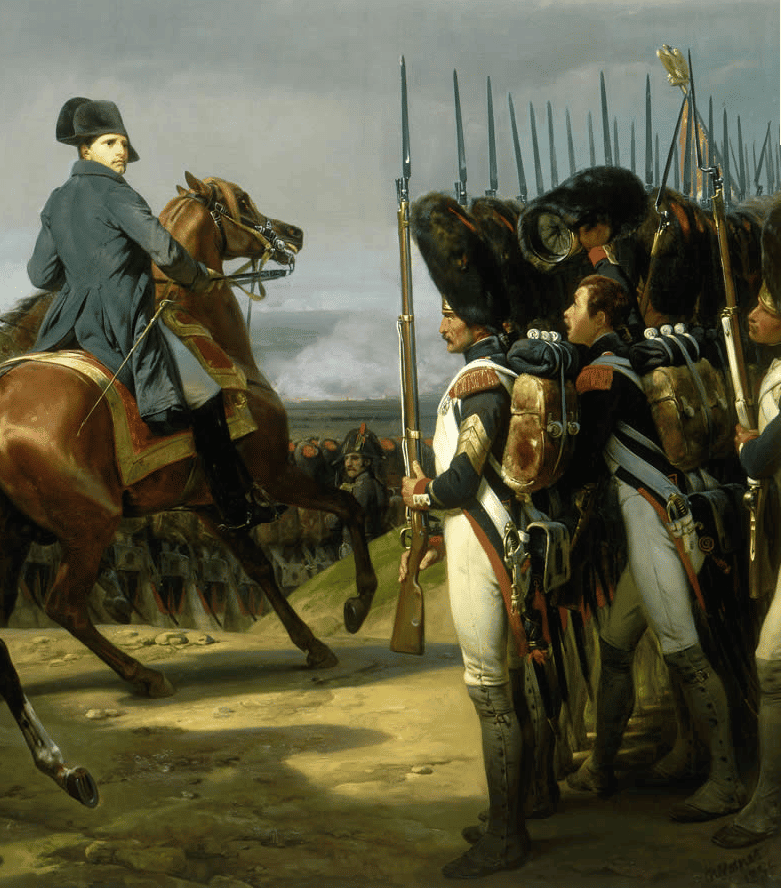
The Charleville musket was, along with the British Brown Bess, one of the most widely used weapons of the 18th and early 19th centuries. It saw action in virtually every major conflict of its time, as France and Britain—two of the world’s largest and most powerful empires—vied for influence across both the Old and New Worlds. In Europe, the Charleville musket was used during the French Revolution and the Napoleonic Wars (1803–1815), as French forces swept across battlefields, conquering one territory after another.
The Charleville musket was the first official standard-issue musket of the French infantry, adopted in 1717. It remained in production into the 1840s. Although its proper name would be the French infantry musket or French model musket, in practice it became widely known as the Charleville musket during the American War of Independence (1775–1783), named after the Charleville arms factory. French-supplied muskets were widely used by American troops, and the weapon left a lasting impression—so much so that American-made copies soon followed. The Springfield Model 1795 musket, along with its improved successors in 1812 and 1816, were directly based on the Charleville musket and continued to serve during the American Civil War (1861–1865).
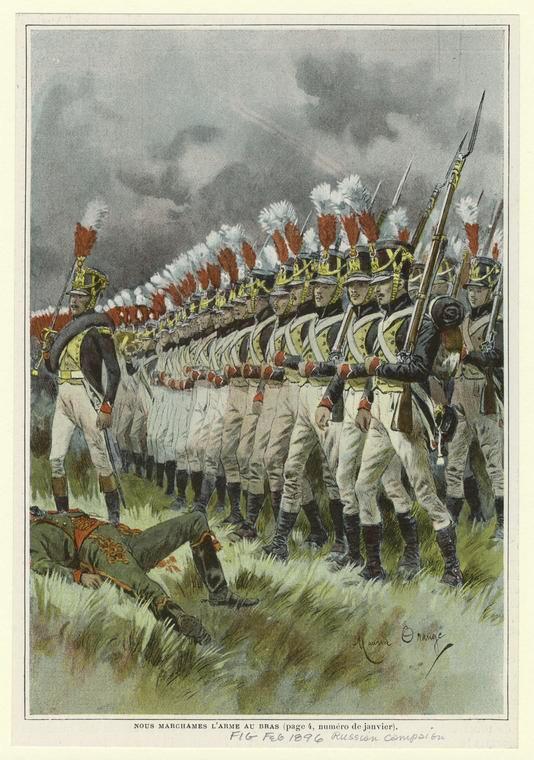
Although Charleville muskets were produced in multiple French arsenals, the name stuck. Over its long production span, the Charleville musket saw many minor updates and refinements. This replica visually and stylistically corresponds to the 1763 model and its later improvements. The 1777 version—Modèle 1777—became the most widespread, with approximately 7 million units produced, more than any other firearm prior to the mass production of World War I. The Charleville 1777 musket was also copied or produced in Austria, Belgium, and Prussia, and the Russian Model 1808 musket was largely a direct copy of this classic weapon.
To load a flintlock musket like the Charleville, black powder was poured into the barrel from a powder horn or inserted as part of a pre-wrapped paper cartridge. A lead ball was then placed on top of the powder and pushed down to the bottom of the barrel using a long ramrod to form a tight charge. When the trigger was pulled, the hammer holding a flint snapped forward and struck the frizzen. The resulting sparks ignited the priming powder in the pan. This small flash traveled through a vent into the main powder charge, firing the musket and sending the bullet toward its target.
The Charleville musket had a smoothbore .69 caliber barrel, meaning it fired large lead balls approximately 17.5 mm in diameter. A well-trained infantryman could load and fire up to three shots per minute. Accuracy was limited: a trained soldier could reliably hit a man-sized target at 40–60 meters and a large enemy formation at about 100 meters. Beyond that, bullet flight paths were unpredictable, and hits became largely a matter of luck.
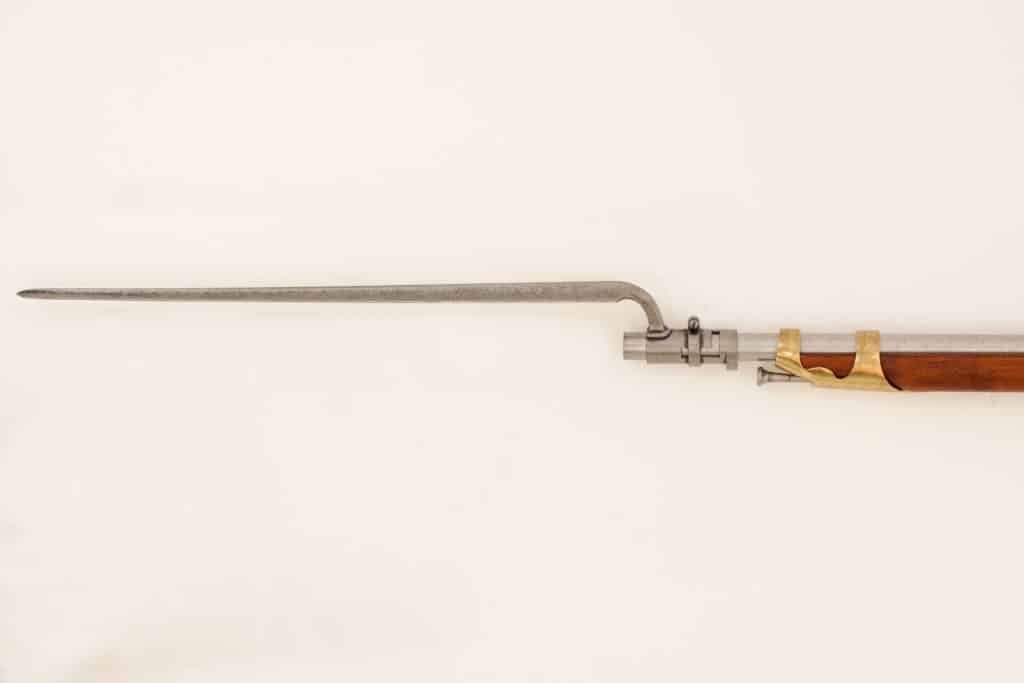
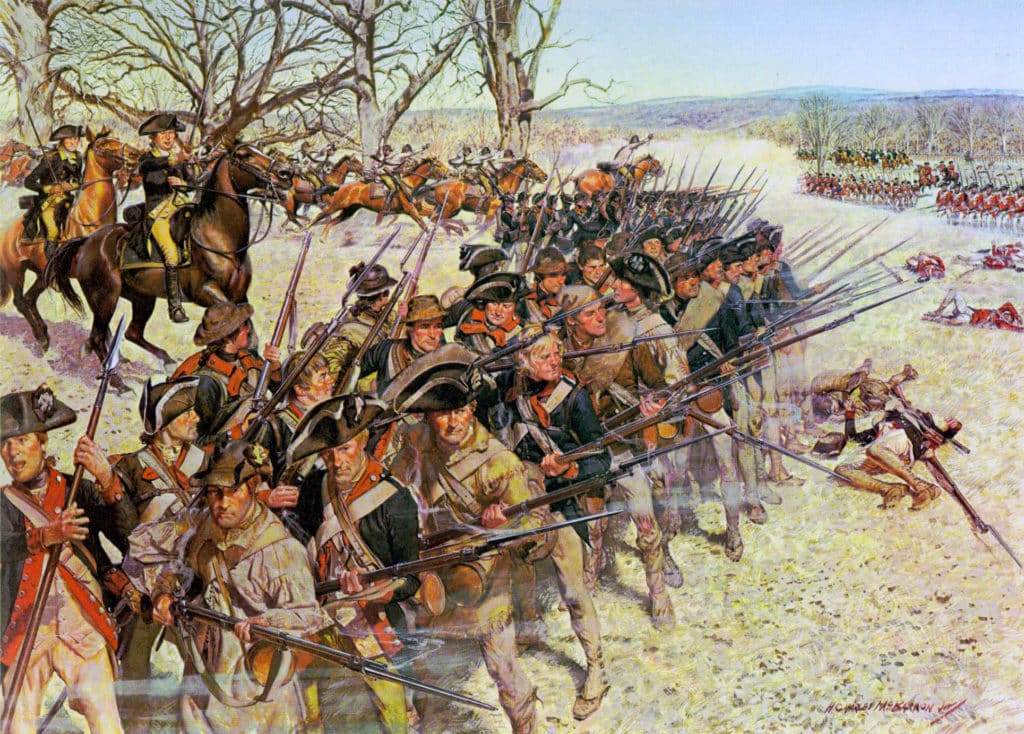
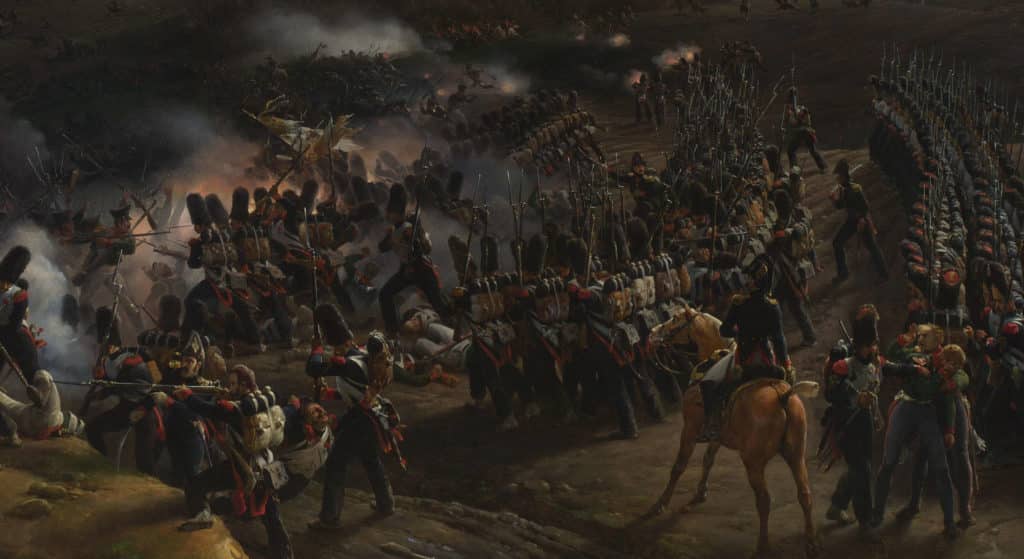
Muskets were not used in battle the way rifles are today. Instead of individual marksmanship, the emphasis was on group firepower: large numbers of soldiers advanced together and fired simultaneously, unleashing a storm of lead against the enemy. Troops fought in close coordination, and after volleys were exchanged, they often rushed forward into hand-to-hand combat. Bayonets were not merely a last resort—they were a central part of battlefield tactics. When fixed to the barrel, the Charleville musket became an effective, spear-like weapon. On many battlefields, roughly one third of the casualties were inflicted not by bullets, but by the bayonet.
- This gun is an exact replica of the original. The replica matches the original in size and weight. The mechanisms of the weapon are working. The weapon can be cocked and dry fired like a real one. The ramrod is not detachable. The bayonet can be removed and reattached. Due to the materials used, the mechanisms cannot withstand continuous cocking and firing for long periods.
- Genuine wood and cast metal has been used to make this replica weapon. Zamac differs from steel in many respects, so the structure of the gun does not withstand pressure, it cannot be used to fire bullets, nor can it be converted to a functional weapon by any means.
- Replica guns such as this do not require permits in Finland, nor in many other countries. However, since the gun looks real, it should not be carried in public.
- A replica gun is perfect for historical re-enactment, on a theater stage, in film productions, for collectors of historical memorabilia, and as decoration.
- Length: 183 cm with bayonet, 140 cm without bayonet
- Weight: 2,8 kg
- Manufacturer: Denix, Spain
Due to the nature of this item please read about shipping options/restrictions if ordering outside Finland. –More information about international shipping-

Absolutely worth visiting. Things to wonder and admire for hours and to buy... Don't tell your spouse unless he/she is also an enthusiast :)
Customers who bought this were also interested in...


Products are located in our own storehouse
In Kaarina, Finland.

Fast shipping
Orders are shipped out within 24 hours of us receiving the order.

Purchase online or offline
You can also pickup your order at our store.

Flexible payments
We accept Credit Cards & Online Banks etc.
Our Store
All orders can also be picked up from the brick-and-mortar store at Oppipojankuja 1, 20780 Kaarina. 10min drive from the centre of Turku.
Welcome!
Reviews
There are no reviews yet.